
 EN
EN
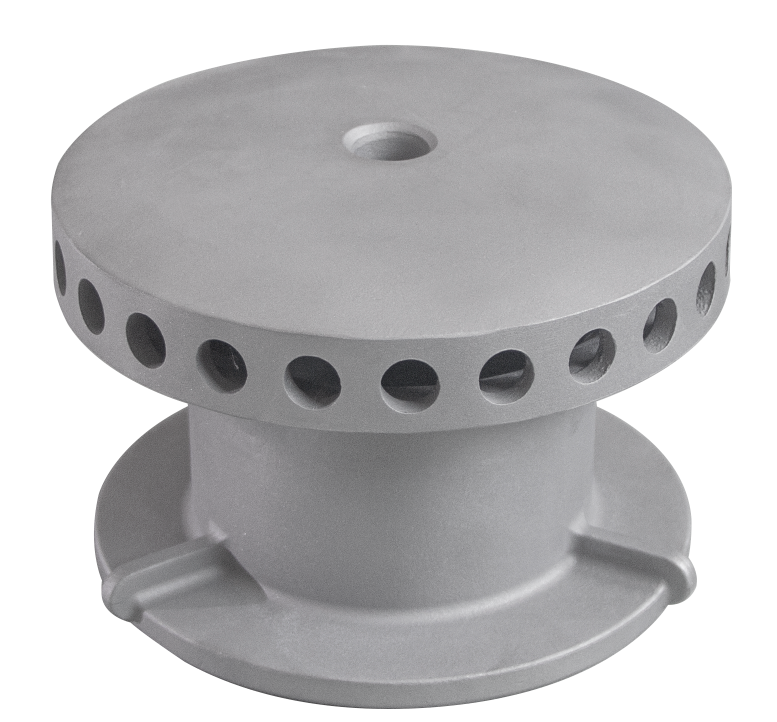
High tolerance metal casting components improve equipment reliability primarily by eliminating localized stress concentration, suppressing fatigue crack initiation, and ensuring system-level assembly compatibility.
By controlling dimensional accuracy, surface integrity, and alloy microstructure during production, precision investment casting directly addresses the root causes of mechanical failure in high-load, high-temperature, and cyclic industrial environments. Partnering with a qualified china precision casting supplier allows OEMs to achieve these strict metallurgical tolerances cost-effectively.
Core Reliability Mechanisms
Mechanism |
Technical Driver |
Operational Benefit |
Stress Distribution |
Micron-level dimensional control; uniform geometry |
Eliminates stress risers, prevents fatigue cracking under dynamic loads |
Fatigue Resistance |
Controlled surface finish; low micro-roughness |
Minimizes crack initiation sites, extending overall service life |
Microstructural Integrity |
Suppressed porosity, shrinkage voids, and grain segregation |
Maintains effective load-bearing area and mechanical strength |
Assembly Alignment |
Precise datum faces, flange interfaces, and bore tolerances |
Prevents rotor-stator rubbing, vibration, and seal degradation |
Batch Consistency |
Standardized tooling, process monitoring, and inspection |
Enables true interchangeability for drop-in maintenance replacements |
Impact Across Key Equipment Components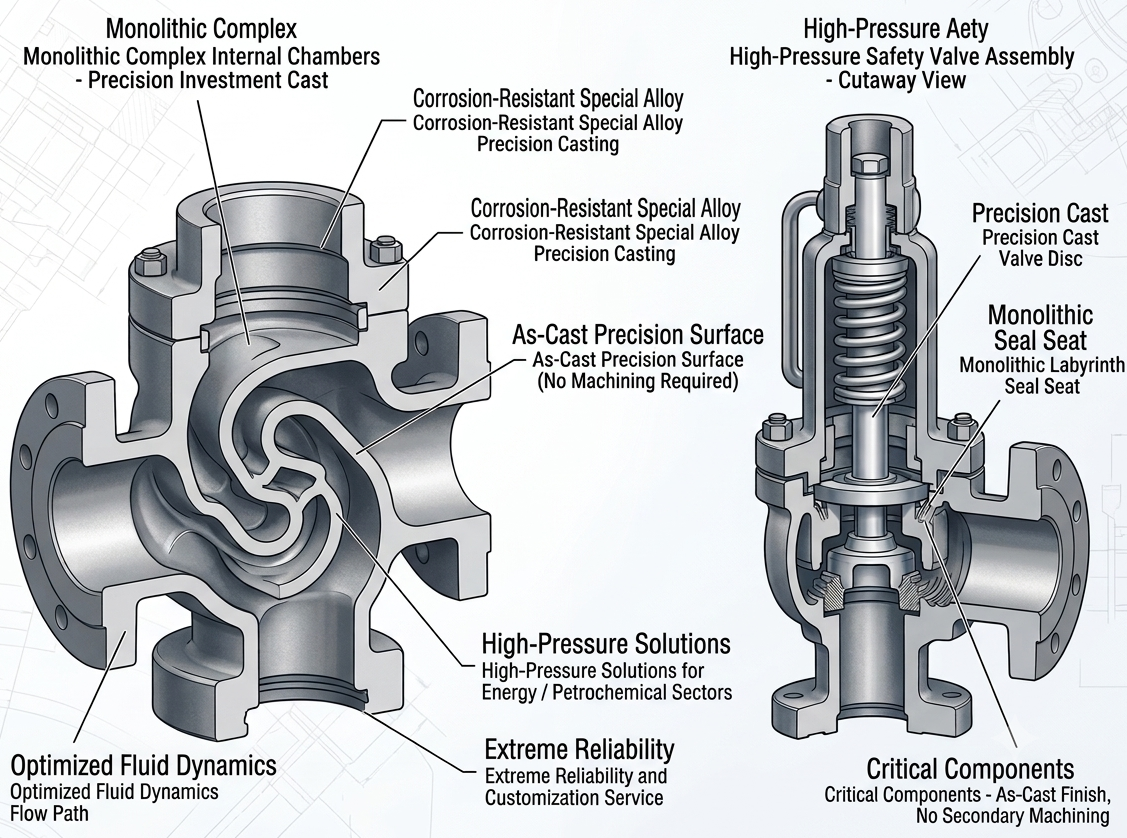
Cross-sectional technical diagram of a precision cast industrial valve, highlighting monolithic design and as-cast surface finish capabilities.
Working with an experienced investment casting manufacturer ensures that critical parts match exact operating conditions:
Rotating Assemblies (Pumps, Compressors, Turbines): Tight shaft and housing tolerances maintain predictable bearing preloads, dampening harmful vibration and reducing long-term bearing wear.
Pressure-Retaining Housings (Valve Bodies, Casing Walls): Precise sealing face geometry ensures uniform gasket compression, preventing process fluid leakage without requiring over-torqued fasteners.
Fluid-Handling Components (Impellers, Flow Volutes): Smooth as-cast internal surfaces lower hydraulic turbulence and resist erosion from particulate-laden fluids.
Quality Verification & OEM Compliance
To ensure oem precision casting components meet high-tolerance specifications, manufacturers rely on a multi-stage inspection protocol:
1.Dimensional Inspection: Coordinate Measuring Machines (CMM) map physical geometry directly against 3D CAD models to verify critical tolerances on machined investment casting parts.
2.Volumetric NDT: Radiographic (X-ray) or Ultrasonic Testing (UT) inspects the internal structure to detect hidden voids, shrinkage, or micro-porosity.
3.Surface & Microstructural Analysis: Profilometers check surface roughness, Optical Emission Spectroscopy (OES) verifies chemistry, and micro-hardness testing validates mechanical strength.