| Parameter / Process | Specification & Technical Highlights | Customer Benefits / Value |
| Product Name | 50-01 Valve Body | Standardized industrial fluid control component layout. |
| Material | Grade 316L Stainless Steel (Ultra-Low Carbon) | Delivers exceptional resistance to pitting, chemical erosion, and intergranular corrosion in water and fluid systems. |
| Application Scenario | Industrial Pipelines / Water Treatment / Fluid Control Systems | Ideal for pressure reducing, altitude, or surge control valve assemblies. |
| Unit Weight | 1.129 kg | Compact and robust heavy-duty wall thickness designed to handle continuous hydraulic pressure. |
| Geometry Feature | Porous and Narrow-Groove Intricate Internals | Advanced internal routing that guides fluid smoothly, minimizing turbulence and pressure drops. |
| Casting Tolerance | ISO 8062 (GB/T6414) CT6 Grade | High near-net-shape accuracy, reducing the secondary CNC machining required for critical O-ring grooves and flange seats. |
| Surface Finish | Uniform Mechanical Polishing | Provides an ultra-smooth finish on "direct use surfaces" to prevent mineral scaling or media buildup inside the valve. |
To ensure fail-safe operation and zero-leakage in pressurized fluid networks, our 50-01 valve bodies undergo severe inspections:
This 50‑01 valve body is presented as a representative custom‑manufactured component for Industrial pipelines; Water treatment; Fluid control systems; Pressure‑reducing, altitude or surge‑control valve assemblies Honyang Cast develops similar parts from customer drawings rather than offering a fixed catalog specification.
The manufacturing plan must connect the part's functional geometry—Porous and narrow‑groove intricate internals; Internal sealing lips, thread depths, mounting guides, O‑ring grooves and flange seats are referenced—with tooling, investment casting, machining and measurable inspection requirements. Final dimensions, interfaces and acceptance criteria are confirmed during drawing review.
PROJECT‑SPECIFIC SUPPLY
Material grade, dimensions, tolerance zones, machining allowance, surface condition, operating requirements and inspection records are confirmed after review of the customer’s 2D drawing, 3D model and project specification.
The parameter set is selected for this component’s function. Unknown values remain drawing‑controlled and must not be replaced with generic catalog data.
| Engineering Item | Reference / Custom Requirement | Verification Basis |
|---|---|---|
| Material grade | Grade 316L Stainless Steel (Ultra‑Low Carbon) | Confirm governing standard and chemistry requirements. |
| Part weight | 1.129 kg | Confirm target weight and allowable variation when relevant. |
| Functional geometry | Porous and narrow‑groove intricate internals; Internal sealing lips, thread depths, mounting guides, O‑ring grooves and flange seats are referenced | Identify drawing datums and critical‑to‑function features. |
| Casting / process reference | Precision casting / investment casting; ISO 8062 (GB/T6414) CT6 casting tolerance; Uniform mechanical polishing; Secondary CNC machining of O‑ring grooves and flange seats | Confirm which steps apply to the quoted production route. |
| Dimensions and tolerances | To be confirmed from customer drawing. | Define casting tolerance separately from machined dimensions and GD&T. |
| Operating conditions | To be specified by customer. | Provide medium, load, temperature, pressure, speed or hygiene requirements as applicable. |
| Recommended additional fields | Customer drawing/revision; Material grade; Unit weight; Nominal interfaces; Port/groove geometry; Casting tolerance; Machining datums; Surface finish; Pressure test; NDT requirement | Complete before publishing numeric claims or quoting production. |
| Structural Feature | Why It Matters | Manufacturing Response |
|---|---|---|
| Porous and narrow‑groove intricate internals | This feature influences fit, flow, load transfer, manufacturability or downstream assembly. | Review core strategy, cavity access, local wall thickness and cleanliness verification for the internal or intersecting features. |
| Internal sealing lips, thread depths, mounting guides, O‑ring grooves and flange seats are referenced | This feature influences fit, flow, load transfer, manufacturability or downstream assembly. | Review core strategy, cavity access, local wall thickness and cleanliness verification for the internal or intersecting features. |
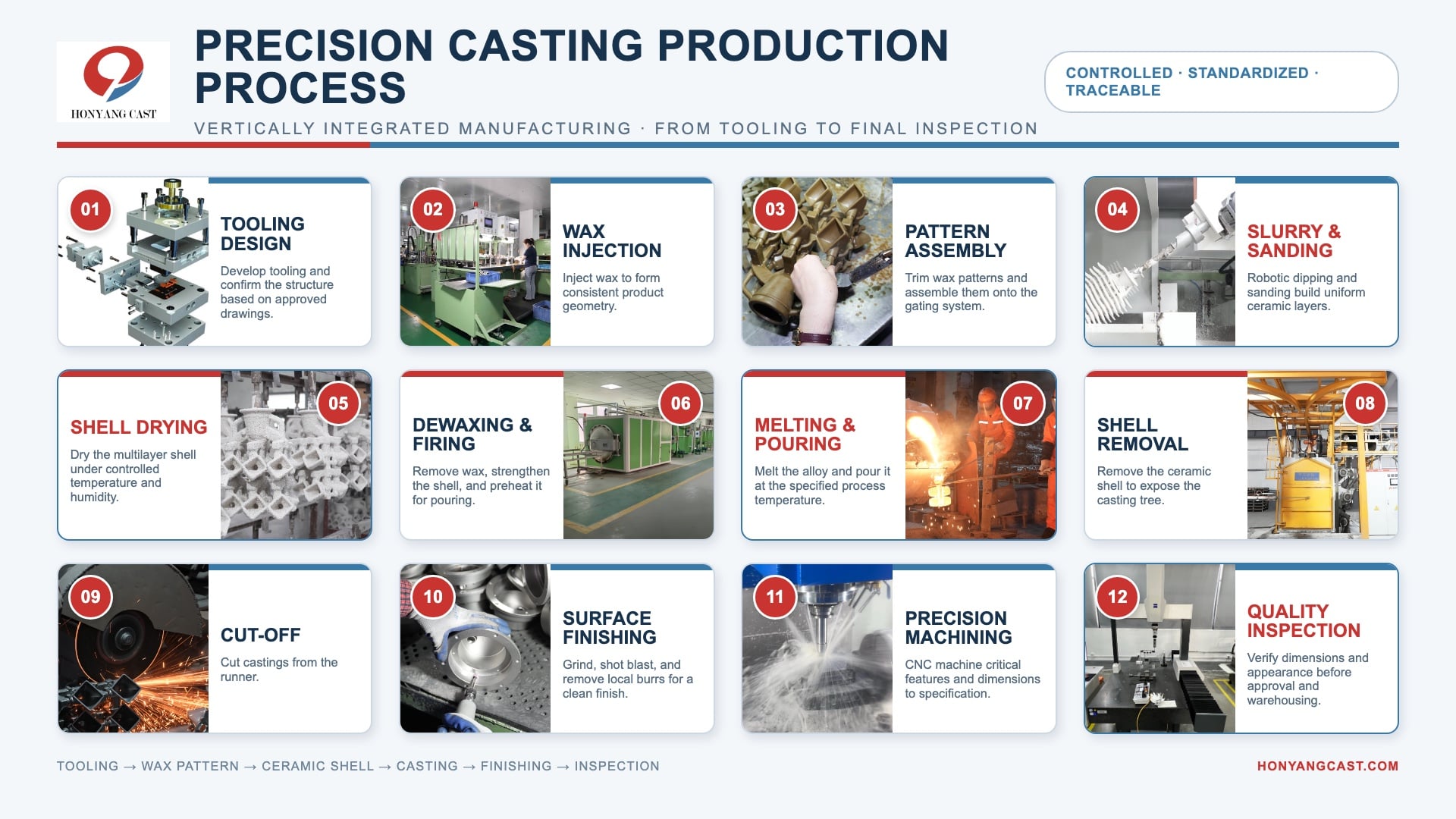
A project‑specific route is established after review of geometry, alloy, tolerance, volume and validation requirements.
Source Page Process References
PROCESS SCOPE
Investment casting and CNC machining are described as the core route. Heat treatment, coating, polishing, balancing, pressure testing, radiographic testing, PPAP or other special processes must be shown as project‑specific unless their scope is confirmed.
Honyang Cast supports drawing‑based development of 50‑01 valve body and related investment cast components from manufacturability review through sample approval and repeat production.
| Application Requirement | Manufacturing Value |
|---|---|
| Drawing‑defined fit and function | A part‑specific DFM and inspection plan links casting geometry to the actual assembly and operating requirement. |
| Integrated complex geometry | Investment casting can consolidate features and reduce fabrication or excessive stock removal where the approved design supports it. |
| Repeatable critical interfaces | Controlled datums, machining and inspection support consistent assembly of functional surfaces and mating features. |
| Material and process traceability | Agreed material and inspection records provide evidence against the drawing and quality plan. |
| Product‑specific value | Use as a custom manufacturing case for compact 316L fluid‑control bodies requiring intricate internal geometry and post‑cast finishing. |
Design Inputs Required From the Customer
SEND YOUR DRAWING FOR A MANUFACTURABILITY REVIEW
Upload the drawing and 3D model for your 50‑01 valve body together with material, quantity, operating conditions and inspection requirements. Our team will review the casting route, machining scope and quality plan before quotation.

Leading manufacturer specializing in precision investment casting and CNC machining of high-performance steel components for critical industrial applications.
 EN