Material:Grade 316 Stainless Steel (CF8M / 1.4408 Marine Grade)
Unit Weight:15.76 kg (Heavy-Duty Scale)
Surface Finish:Uniform Clean Shot-Blasting
Casting Tolerance:ISO 8062 (GB/T6414) CT6 Grade
| Parameter / Process | Specification & Technical Highlights | Customer Benefits / Value |
| Material | Grade 316 Stainless Steel (CF8M / 1.4408 Marine Grade) | Provides excellent, long-term defense against corrosive marine environments, seawater exposure, and salt spray. |
| Application Scenario | Shipbuilding / Marine Systems / Maritime Fluids & Structural Layouts | Ideal for heavy-load marine mechanisms, large fluid control housings, or deck-adjacent structural hardware. |
| Unit Weight | 15.76 kg (Heavy-Duty Scale) | Demonstrates proven factory capability in pouring large-scale, high-density stainless steel parts with consistent wall integrity. |
| Pouring System | Optimized Multi-Gate Gating System | Multi-directional fluid routing eliminates internal shrinkage cavity risks and structural micro-porosity in thick-walled sections. |
| Deformation Control | Precision Post-Casting Straightening Process | Corrects inherent long-span thermal contraction stress; standard-guaranteed flatness ensures immediate assembly alignment. |
| Casting Tolerance | ISO 8062 (GB/T6414) CT6 Grade | High near-net-shape accuracy simplifies secondary CNC setups, cutting down processing time and material waste. |
| Surface Finish | Uniform Clean Shot-Blasting | Leaves a dense, stress-relieved, and beautifully clean matte finish ready for premium maritime field services. |
To comply with the high-reliability safety standards of global shipbuilding pipelines, our quality insurance implements strict control over dimensions and structural density:
This cage is presented as a representative custom‑manufactured component for Shipbuilding; Marine systems; Maritime fluids and structural layouts; Heavy‑load marine mechanisms; Fluid‑control housings; Deck‑adjacent structural hardware Honyang Cast develops similar parts from customer drawings rather than offering a fixed catalog specification.
The manufacturing plan must connect the part's functional geometry—Long‑span mounting datum faces; Heavy flange layouts and critical bores—with tooling, investment casting, machining and measurable inspection requirements. Final dimensions, interfaces and acceptance criteria are confirmed during drawing review.
PROJECT‑SPECIFIC SUPPLY
Material grade, dimensions, tolerance zones, machining allowance, surface condition, operating requirements and inspection records are confirmed after review of the customer’s 2D drawing, 3D model and project specification.
The parameter set is selected for this component’s function. Unknown values remain drawing‑controlled and must not be replaced with generic catalog data.
| Engineering Item | Reference / Custom Requirement | Verification Basis |
|---|---|---|
| Material grade | Grade 316 Stainless Steel (CF8M / 1.4408 Marine Grade) | Confirm governing standard and chemistry requirements. |
| Part weight | 15.76 kg (Heavy‑Duty Scale) | Confirm target weight and allowable variation when relevant. |
| Functional geometry | Long‑span mounting datum faces; Heavy flange layouts and critical bores | Identify drawing datums and critical‑to‑function features. |
| Casting / process reference | Optimized multi‑gate gating; Post‑casting straightening; Uniform shot blasting; ISO 8062 (GB/T6414) CT6 casting tolerance | Confirm which steps apply to the quoted production route. |
| Dimensions and tolerances | To be confirmed from customer drawing. | Define casting tolerance separately from machined dimensions and GD&T. |
| Operating conditions | To be specified by customer. | Provide medium, load, temperature, pressure, speed or hygiene requirements as applicable. |
| Recommended additional fields | Envelope dimensions; Wall thickness; Flatness; Bore positions; Machining allowance; Surface finish | Complete before publishing numeric claims or quoting production. |
| Structural Feature | Why It Matters | Manufacturing Response |
|---|---|---|
| Long‑span mounting datum faces | This feature influences fit, flow, load transfer, manufacturability or downstream assembly. | Translate the feature into drawing datums, casting controls, machining scope and measurable inspection characteristics. |
| Heavy flange layouts and critical bores | This feature influences fit, flow, load transfer, manufacturability or downstream assembly. | Define datums, sealing or mating interfaces, machining allowance and integrity checks for the pressure or structural boundary. |
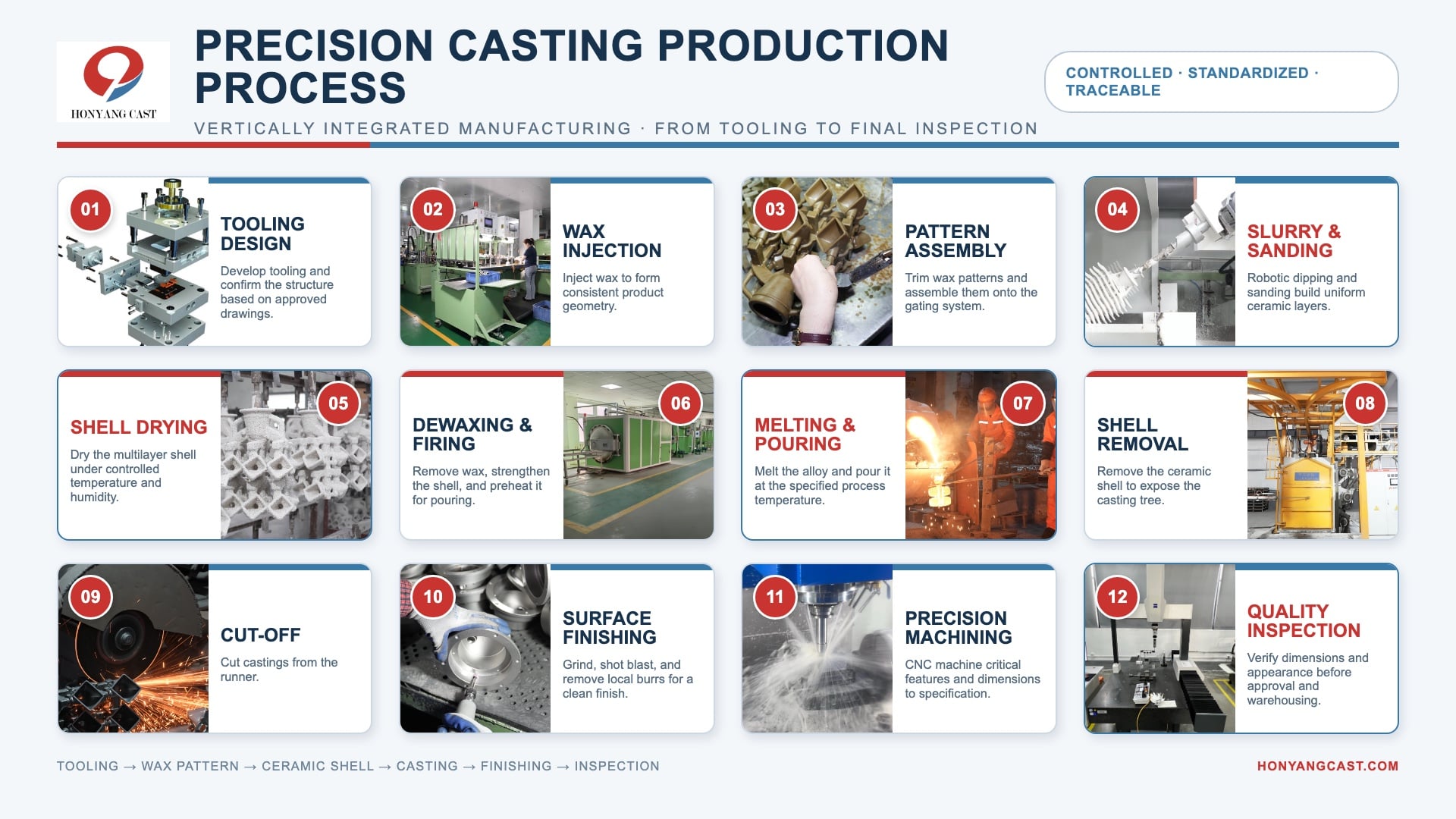
A project‑specific route is established after review of geometry, alloy, tolerance, volume and validation requirements.
Source Page Process References
PROCESS SCOPE
Investment casting and CNC machining are described as the core route. Heat treatment, coating, polishing, balancing, pressure testing, radiographic testing, PPAP or other special processes must be shown as project‑specific unless their scope is confirmed.
Honyang Cast supports drawing‑based development of cage and related investment cast components from manufacturability review through sample approval and repeat production.
| Application Requirement | Manufacturing Value |
|---|---|
| Drawing‑defined fit and function | A part‑specific DFM and inspection plan links casting geometry to the actual assembly and operating requirement. |
| Integrated complex geometry | Investment casting can consolidate features and reduce fabrication or excessive stock removal where the approved design supports it. |
| Repeatable critical interfaces | Controlled datums, machining and inspection support consistent assembly of functional surfaces and mating features. |
| Material and process traceability | Agreed material and inspection records provide evidence against the drawing and quality plan. |
| Product‑specific value | Support assembly alignment; Reduce downstream machining setup; Provide marine corrosion resistance |
Design Inputs Required From the Customer
SEND YOUR DRAWING FOR A MANUFACTURABILITY REVIEW
Upload the drawing and 3D model for your cage together with material, quantity, operating conditions and inspection requirements. Our team will review the casting route, machining scope and quality plan before quotation.

Leading manufacturer specializing in precision investment casting and CNC machining of high-performance steel components for critical industrial applications.
 EN