| Parameter / Process | Specification & Technical Highlights | Customer Benefits / Value |
| Material | G-X5CrNiNb18-9 | Exceptional thermal fatigue strength and intergranular corrosion resistance at extreme temperatures; ideal for high-heat automotive environments. |
| (EN 1.4552 / Niobium-Stabilized Steel) | ||
| Application Scenario | Automotive Field / Exhaust Systems / Turbocharger & Thermal Management | Engineered to withstand high-vibration and aggressive hot gas flow in passenger or commercial vehicles. |
| Unit Weight | 0.883 kg | Lightweight yet high-strength structural design tailored for automotive space-saving layouts. |
| Geometry Feature | Multi-heat-joint irregular-shaped pipe bend | Integrates multiple flow paths into a single compact component, reducing the need for multi-part welding. |
| Core Process | Water-Soluble Core Molding for internal cavity | Creates a seamless, ultra-smooth inner hole layout that eliminates flow restriction and optimizes exhaust fluid dynamics. |
| Casting Tolerance | ISO 8062 (GB/T6414) CT6 Grade | Precise flange and mating port tolerances ensure seamless assembly with automotive manifolds or piping. |
To meet the rigorous durability and safety criteria of the automotive supply chain, our components undergo strict quality verification:
This bend with column is a representative custom‑manufactured stainless steel casting for automotive exhaust, turbocharger and thermal‑management assemblies. It connects and redirects high‑temperature gas flow within a compact installation space while maintaining the required relationship between the flange, branch connection and internal passage.
Because the part combines an irregular curved body, multiple thermal‑joint features and an enclosed flow path, its manufacturability depends on coordinated tooling, core design, wax‑pattern assembly, ceramic‑shell control, casting, finishing and dimensional verification. Honyang Cast manufactures similar components to customer drawings rather than supplying a fixed standard item.
PROJECT‑SPECIFIC SUPPLY
The dimensions, wall thickness, port geometry, machining allowance, surface condition and validation plan are confirmed after review of the customer’s 2D drawing, 3D model and operating requirements.
Only parameters that influence this component’s function and manufacturability should be specified. The following table separates known reference information from project inputs that must be confirmed from the drawing.
| Engineering Item | Reference / Custom Requirement | Verification Basis |
|---|---|---|
| Alloy | G‑X5CrNiNb18‑9 / EN 1.4552 reference | Chemical composition verified by spectrometric analysis as agreed |
| Part weight | 0.883 kg reference | Production weight check or approved sample |
| Casting accuracy | ISO 8062 / GB/T 6414 CT6 where applicable | Dimensional report against drawing |
| Internal passage | Water‑soluble core process referenced for the enclosed flow path | Visual cleanliness, gauges or project‑specific section/flow check |
| Wall thickness | To be confirmed from customer drawing | Drawing‑defined points and inspection plan |
| Flange and port position | To be confirmed from customer drawing | CMM, fixture or gauges as appropriate |
| Machined interfaces | To be confirmed from customer drawing | Dimensional and surface‑finish inspection |
| Operating conditions | Customer to specify temperature, pressure, vibration and medium | Application specification |
| Surface condition | Shot blasting, pickling or project‑specific finish as agreed | Approved visual or surface standard |
| Structural Feature | Why It Matters | Manufacturing Response |
|---|---|---|
| Irregular curved flow path | Core shift or local restriction can affect passage geometry and flow behavior. | Review core support, tooling orientation and dimensional verification around critical sections. |
| Multiple branch / joint interfaces | Port misalignment can create assembly stress or require excessive downstream correction. | Define common datums and verify flange, branch and mating positions against the customer CAD model. |
| Thin‑to‑thick transitions | Uneven solidification may increase distortion or local shrinkage risk. | Review gating, feeding and process parameters; apply targeted inspection when specified. |
| Heat‑exposed alloy and geometry | Material chemistry and joint geometry influence thermal‑cycle durability. | Control alloy identification, casting route and project‑specific finishing or heat treatment requirements. |
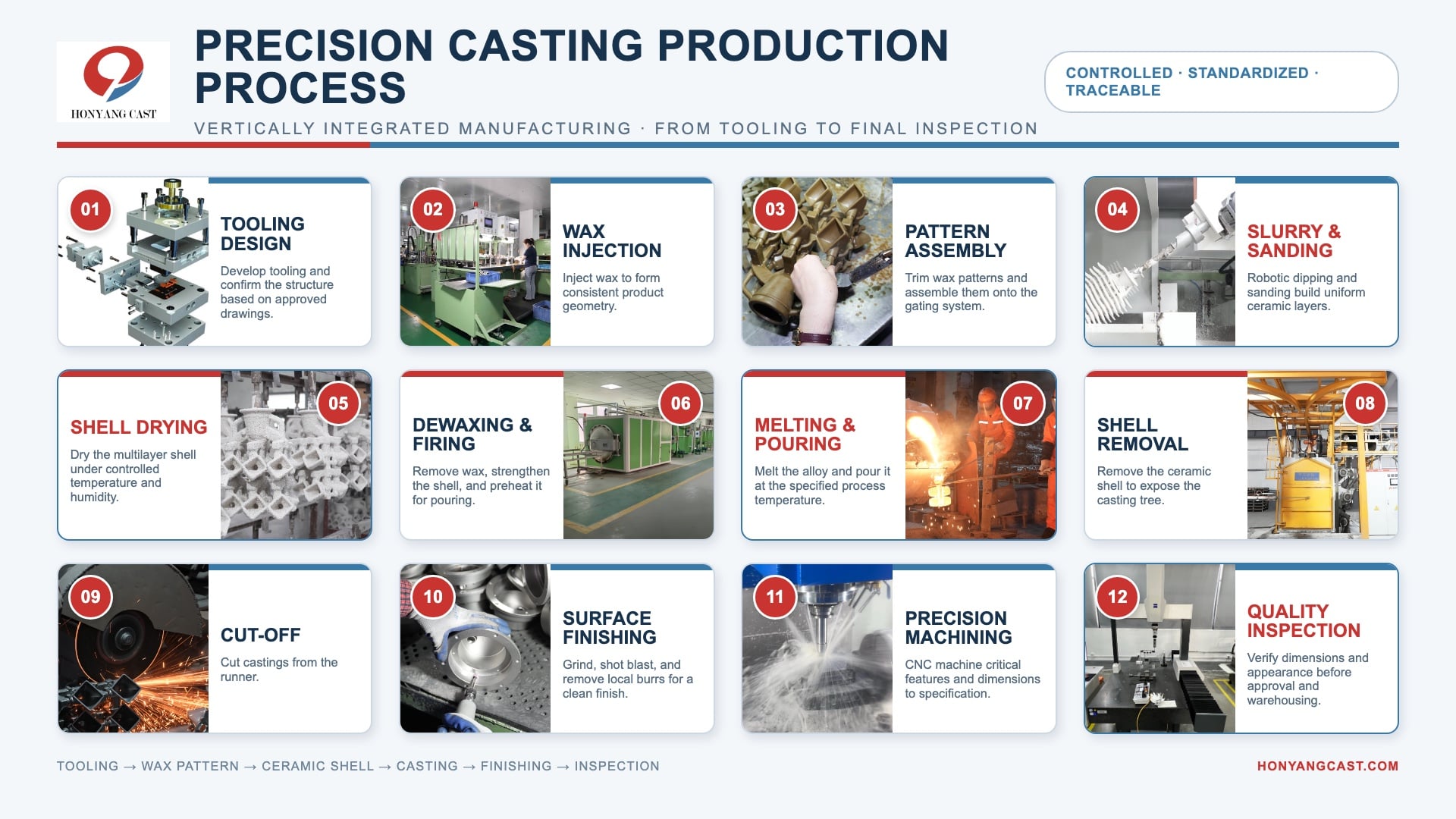
A project‑specific process route is established after the geometry, alloy, tolerance, annual volume and validation requirements are reviewed.
PROCESS SCOPE
Investment casting and CNC machining are core manufacturing steps. Special heat treatment, coating, radiographic testing, pressure testing, PPAP or other customer‑specific processes should be listed only when required by the project and confirmed by Honyang Cast.
Honyang Cast supports drawing‑based development of complex stainless steel castings from initial manufacturability review through sample approval and repeat production.
| Application Requirement | Manufacturing Value |
|---|---|
| Compact hot‑gas routing | An integrated cast geometry can consolidate complex flow routing and reduce reliance on multiple fabricated joints, subject to the approved design. |
| Assembly alignment | Controlled flange, branch and port positions support repeatable installation and reduce downstream correction. |
| High‑temperature service | Verified alloy chemistry and an application‑specific process route support the material behavior required by the customer specification. |
| Flow‑path integrity | Core design, cleaning and passage verification help control restrictions that could affect gas flow. |
| Project traceability | Agreed material, dimensional and NDT records provide evidence against the drawing and quality plan. |
Design Inputs Required From the Customer
SEND YOUR DRAWING FOR A MANUFACTURABILITY REVIEW
Upload your 2D drawing and 3D model together with the material, annual quantity, operating conditions and inspection requirements. Our team will review the casting route, core strategy, machining scope and quality plan before quotation.

Leading manufacturer specializing in precision investment casting and CNC machining of high-performance steel components for critical industrial applications.
 EN